
Sensitivity is the second of five caregiving dimensions that together form the Secure Base Model. This article looks at how it might apply to your role as a foster carer, and the likely developmental benefits for your foster child.
Helping your foster child to manage their feelings and behaviour.
What Do We Mean by Sensitivity?
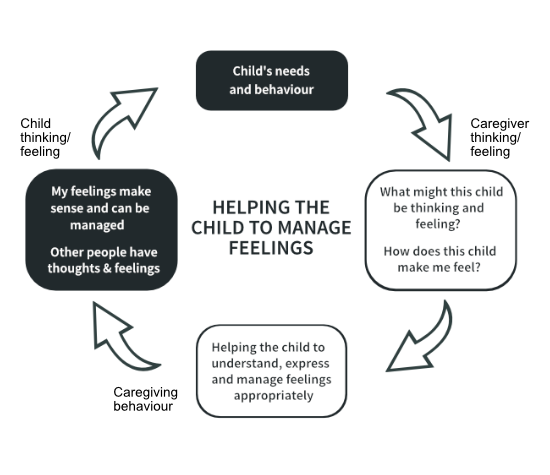
Sensitivity, when it comes to fostering children, is a special quality that you need to bring to your role. It describes the way in which you are so able to identify with your child’s needs and perspective, that you can virtually see the world from their point of view – ‘put yourself in their shoes’.
You will have a clear idea of what you imagine your foster child is feeling and thinking, and be able to reflect these ideas back to them. You will also be able to share your thoughts and feelings, in an appropriate way that’s acceptable to them.
By doing this, and by helping your foster child to identify and evaluate their thoughts and feelings, you will help them to validate their impressions and interpretations about the world around them and the people they come into close contact with.
This diagram illustrates how sensitivity works within the caregiving cycle.
How Will This Approach Help Your Relationship with Your Foster Child?
You will find ways of helping them to categorise and organise their thoughts and feelings, perhaps for the first time in their life. This is important and fundamental to their ability to express their inner world.
Your foster children will also learn to acknowledge the feelings of others, a major step towards making meaningful relationships. Gradually, they will deepen their ability to understand and to be understood.
Your Foster Child’s Experience
It’s important for you to know and bear in mind, what your foster child’s experience has been around these thoughts and feelings so far. This will make it easier for you to empathise with the way they react to certain things.
You can easily imagine how isolated and lonely this might make a child feel. And some past caregivers may even have tried to suppress, or brush aside, the child’s need to own and explore strong feelings.
[mepr-show if="loggedout"]
Sorry! You need to log in to continue reading this. Not a member? See the benefits of becoming a CAREHUB Fostering Community Member. It’s free!
[/mepr-show]
[mepr-active rule="40490" ifallowed="show"]
What Lies Behind This Emotionally Impoverished Relationship?
Sometimes the caregivers themselves may be struggling with their own difficulties and therefore can’t help the child to identify the reality, or otherwise, of what they think and feel in a given situation. Such caregivers may have been so absorbed in their own emotional needs that they will have failed to appreciate, or even notice, those of their child.
What Might the Consequences Be?
In turn, the child will have ‘nowhere to go’ emotionally and will often internalise the chaotic and violent feelings of their former caregiver. They might experience destructive feelings of self-blame and an idea that they are somehow responsible for the unsatisfactory situation within the home. Lacking a well ordered, supportive and sensitive framework, the child will have developed his own ways of dealing with his feelings.
By the time they come to you, they might be showing uninhibited and uncontrolled ‘outbursts’, tightly controlled feelings, strong denial of the existence of such feelings, or signs of attempting to control other people’s behaviour.
They will not have had the ‘normal’ opportunity of exploring their feelings within a loving family setting based on trust and ordered discussion, where it is ‘safe’ to express themselves and come to terms with stressful or challenging situations.
How Can You Best Approach the Care of a Child Who's Experienced This Early Deprivation?
It isn’t easy to put yourself in the child’s shoes. Yet you must strive to do this and to ask yourself what could be going on in your foster child’s mind, given all the past circumstances. How have they learned to cope with the bewilderment and insensitive handling they have grown up with so far? What responses have they met with when they’ve needed to process their experiences? This need to empathise with the child can be a painful exercise.
To identify with a child who has experienced neglect, abuse, unprovoked anger and other negative responses, can cause you real anguish. But it’s through trying to do this that you will develop the skills to understand why they might be behaving in a certain way and what their expectations of themselves and others might be. You will need to bear in mind the child’s history and how even small day to day events might evoke powerful emotions. You’ll also need to learn to pick up on little clues about why their thoughts, feelings, and reactions are what they are.
Who Can Help You to Deal Constructively with This?
An experienced and dispassionate social worker can be invaluable in helping you to own your feelings about the child and to voice how the child really makes you feel. Such a social worker will be able to reflect on the painful aspects of your foster child’s history with accuracy and honesty, without being overwhelmed.
If you can find this supportive framework, you will find it easier to begin to help your foster child to express their feelings appropriately. You will find it helpful to name these feelings with the child and to help them to recognise where they might have sprung from.
Some children will need help to bring their feelings to the surface and express them freely, others will need to be helped to curb the expression of them a little!
When it comes to the child learning about the feelings of others, you must be prepared to look at your own feelings and responses, acknowledging that it is normal to have mixed feelings, including negative ones such as anger. You can help them to understand that these feelings can be managed and that everyone experiences contradictory emotions at times. (Love and anger for instance, or looking forward happily to an event while feeling a bit anxious.) You can reassure them that everyone, including members of their birth family, social workers, foster carers, and friends, will sometimes have mixed feelings in certain situations, and that this is ‘okay’.
How Can a Sensitive Approach by You Help Your Foster Child?
Through your sensitive approach, your foster child will learn that their feelings can be understood and managed and that they don’t need to be overwhelmed by them. They can also begin to appreciate that other people’s thoughts and feelings must be taken into account too, in the new relationships they are forming.
As your foster child develops and their behaviour becomes better organised and regulated, there will be increasing opportunities for the formation of these new relationships, and their overall behaviour will move towards being more socially acceptable and empathic. These changes will happen gradually and patience and consistency on your part will help to bring about this very important progress in your fostering journey.
Sensitivity within the Secure Base Model focuses on how to help your foster child manage their feelings. The next dimension ‘Acceptance‘ is about helping them to build their self-esteem.
 If you found this guide to foster care helpful, share it with people you know…
[/mepr-active]

ENJOY THE FCM TOP 10
Receive the 10 most valuable pieces of content we find for foster carers every fortnight.